I spent a year working as a zookeeper at ZSL London Zoo before becoming a developer. That experience taught me more about problem-solving, observation, and adaptability than any coding bootcamp ever could.
April 13, 2026
.webp)
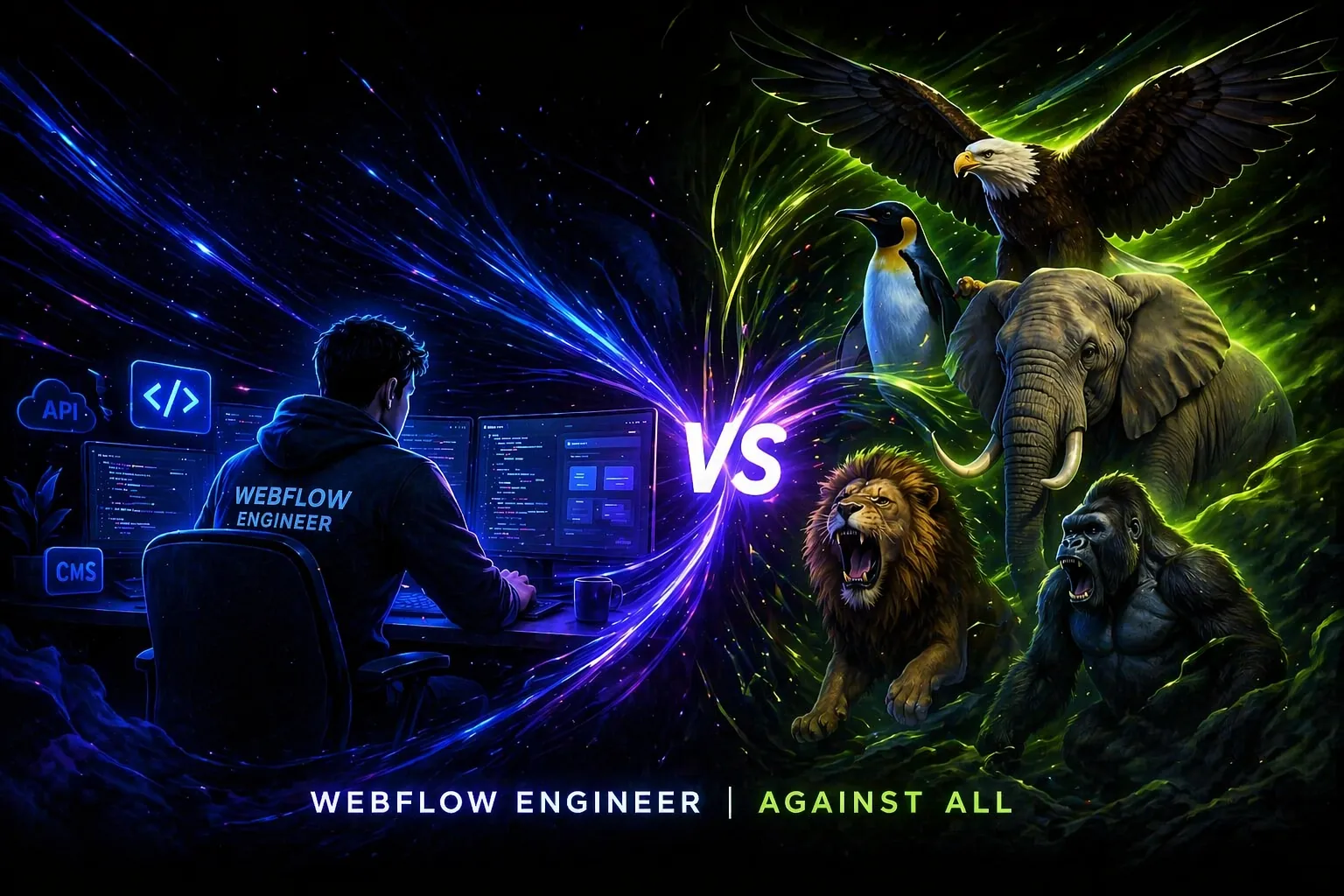
Before I wrote my first line of production code, I was looking after animals at ZSL London Zoo. Before that, I was a veterinary care assistant at PDSA.
When people see my CV, the zoo part always gets a reaction. Usually it's amusement, sometimes curiosity, occasionally confusion. "How do you go from zookeeper to Webflow developer?" As if the two couldn't possibly be connected.
But they are. More than most people realise.
There's a well-documented shift happening in tech hiring. Major companies Google, Apple, IBM, Accenture have removed degree requirements from the majority of their positions. Stack Overflow's developer surveys consistently show that over 40% of professional developers are self-taught with no formal computer science education. CompTIA research indicates that nearly one in three tech workers entered the industry from an unrelated field.
The old gatekeeping model, where you needed a CS degree from the right university to get taken seriously is breaking down. And that's a good thing, because the research on cognitive diversity is clear: teams with varied professional backgrounds solve problems faster and more creatively than homogeneous ones.
Harvard Business Review found that cognitively diverse teams can solve problems up to three times faster. Boston Consulting Group found that organisations with diverse leadership reported innovation revenue at nearly double the rate of less diverse companies. This isn't feel-good corporate messaging. It's measured data.
Let me connect this back to my own experience, because the skills I developed at ZSL London Zoo translate directly into how I work as a developer today.
Observation and pattern recognition - at the zoo, you're monitoring animals constantly for subtle changes in behaviour that might indicate stress, illness, or environmental problems. You learn to notice small things that most people would miss. That exact skill is what makes me good at debugging and catching UI inconsistencies. The same instinct that told me a primate was behaving differently before anyone else noticed is the same instinct that helps me spot a layout shift or a broken interaction before a client files a complaint.
Managing complex systems - coordinating feeding schedules, health records, environmental controls, and visitor interactions across multiple species simultaneously requires systems thinking. You can't just focus on one animal; everything is interconnected, and a change to one enclosure's routine can ripple across the entire section. That's the same mental model you need when managing frontend, backend, CMS architecture, and deployment pipelines. Everything connects.
Adapting to unpredictable situations, animals don't follow scripts. Neither do client requirements. The ability to stay calm when plans change, assess the new situation quickly, and adjust your approach without losing the thread of what you were doing. That's a skill I developed through genuinely unpredictable working conditions. A baboon escaping its enclosure teaches you more about priority management than any project management course.
Patience and incremental progress animal training works through positive reinforcement, applied consistently over long periods. You don't get results by forcing the outcome. You get results by showing up every day, being consistent, and building trust gradually. That's identical to how I approach iterative development. Ship, test, improve, repeat.
One aspect of my zoo work that directly applies to my current role is public communication. At ZSL, I delivered regular talks and educational presentations to large visitor groups. I explained complex topics, animal behaviour, conservation challenges, ecological relationships, to audiences with no specialist knowledge.
That skill transfers directly into client work. When I'm explaining CMS architecture or SEO strategy to a stakeholder who doesn't have a technical background, I'm using the same communication framework I developed at the zoo. Make it clear, make it relevant, and never talk down to your audience.
I'm not the only person in tech with an unusual background. Stewart Butterfield, the co-founder of Slack and Flickr, studied philosophy at university and completed a Master's degree at Cambridge. He grew up in a log cabin without electricity. He's credited his philosophy education with teaching him to write clearly and to follow arguments to their logical conclusion, skills he considers essential for running effective meetings and making good product decisions. Slack was eventually acquired by Salesforce for over 27 billion dollars.
The tech industry is full of people whose most valuable skills came from outside tech. The musician who became a developer and improved code quality through superior pattern recognition. The linguist who builds better APIs because they understand how language structures work. The teacher who writes better documentation because they know how to explain things.
If you're reading this as someone who hires developers, consider what you're actually looking for. Yes, technical skills matter. But the ability to communicate clearly, observe carefully, adapt to changing requirements, manage complexity, and maintain quality under pressure, these are often harder to find and harder to teach than any specific programming language.
I brought those skills into tech from a zoo, a veterinary clinic, and a retail floor. And they've been more valuable to my career than any single technical certification.
The transition isn't easy. I went through a full-stack bootcamp at BrainStation, spent years freelancing and building projects, and earned certifications to validate my skills. The work ethic came from my previous careers; the technical knowledge came from deliberate study and practice.
But the unconventional path gives you something that a straight-line career doesn't: perspective. When everyone on a team has the same educational background and the same career trajectory, they tend to approach problems the same way. The person who came from a completely different world sees angles that others miss.
That's not a disadvantage. That's a superpower.