
Honest lessons from founding a subscription-based Webflow development agency - what worked, what didn't, and why productised services are the future for solo developers.
April 12, 2026
.webp)
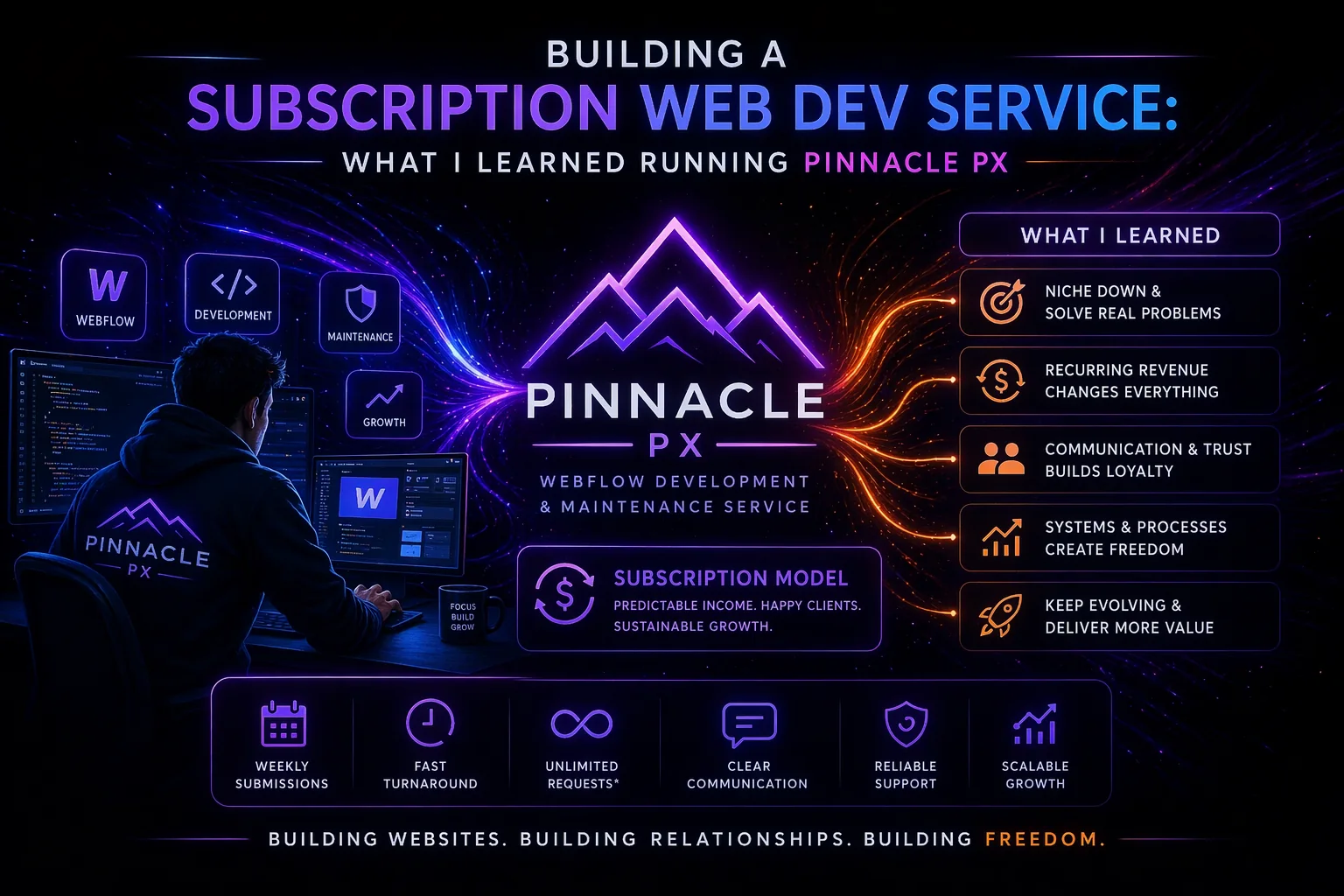
In September 2022, I founded Pinnacle Px - a Webflow-focused agency that I ran for three years. During that time, I built and shipped over 20 client websites, managed the full lifecycle from discovery through to ongoing retainer support, and eventually introduced a subscription-based service model that changed how I thought about the entire business.
I want to talk about the subscription model specifically, because it was the most interesting decision I made and it taught me more about running a web development business than any individual project ever did.
Like most freelancers, I started with project-based pricing. Client wants a website, I quote a price, we agree on a scope, I build it, they pay. Simple.
Except it isn't simple. Every project involved a discovery phase, a scoping phase, back-and-forth on requirements, a build phase, revisions, QA, handover documentation, and then inevitably a few follow-up requests that fell into a grey area between "included" and "additional work." The overhead of managing each project as a standalone engagement was enormous relative to the actual development time.
Cash flow was unpredictable. One month I'd close two projects and feel comfortable. The next month I'd be in a gap between projects, scrambling to fill the pipeline while also delivering on existing commitments. It was the classic freelancer trap: you're either doing the work or finding the work, and there's never enough time for both.
The concept was straightforward: instead of quoting per-project, clients would pay a monthly fee for ongoing Webflow development. They'd submit requests, I'd work through them one at a time, and we'd maintain a continuous working relationship rather than starting from scratch every few months.
I wasn't the first to try this. DesignJoy, founded by Brett Williams, popularised the subscription design model and built it into a seven-figure solo operation. Companies like ManyPixels and Penji scaled the concept with teams. But most of these services focused on graphic design. I wanted to apply it specifically to Webflow development builds, updates, CMS architecture, custom interactions, SEO improvements.
The idea was to make quality Webflow development more accessible to smaller businesses who couldn't justify a five-figure one-off project but needed consistent, ongoing work.
The biggest win was predictable revenue. Knowing what's coming in each month changes everything about how you operate. You can plan. You can invest in better tools. You can say no to bad-fit clients without panicking about the cash flow gap.
The second win was relationship depth. When you're working with a client continuously, you build genuine understanding of their brand, their goals, and their technical constraints. You stop having the same onboarding conversation every time. You know their CMS structure because you built it. You know their brand guidelines because you've been applying them for months. That depth of context makes the work better and faster.
The third win was standardisation. When you're delivering a similar type of work repeatedly, you develop systems. I built internal standards for CMS architecture, class naming conventions, and component libraries that I could apply across every client. These standards are still in use across the portfolio today. They made handovers cleaner, reduced bugs, and meant that any client's site could be picked up and understood by someone other than me.
Scope management was the hardest part. With a subscription model, there's a natural tension: the client feels like they've paid for unlimited access, but you're still a finite resource. Early on, I didn't have clear enough boundaries around what constituted a "request" versus what was really a full project in disguise.
I learned quickly that one-request-at-a-time was the only model that worked. The client submits one request, I complete it, they review and approve, then we move to the next one. It created a natural bottleneck that prevented scope from spiralling while still giving the client a feeling of continuous progress.
Revision limits mattered too. Without them, a single request could cycle through unlimited rounds of feedback and eat up the entire month's capacity. Two rounds of revisions per request, with anything beyond that scoped as a new request, kept things moving.
Getting pricing right took experimentation. Too low and you attract clients who need the most hand-holding but have the least budget. Too high and you're competing with agencies that offer a full team. The sweet spot was positioning the service as premium enough to attract clients who valued quality and understood that cheaper doesn't mean better, but accessible enough that it undercut traditional agency pricing by a significant margin.
One thing I wish I'd understood earlier: raising prices doesn't scare off good clients. It attracts better ones. The clients who haggled over a few hundred pounds were always the ones who needed the most revisions, sent the vaguest briefs, and were hardest to satisfy. The clients who paid a fair rate were organised, respectful of my time, and usually the most enjoyable to work with.
As the business grew, I brought on collaborators. Maintaining quality consistency was harder than I expected. The internal standards I'd built helped class naming conventions, CMS templates, QA checklists but there's always a gap between documented standards and how they're applied in practice.
I spent a lot of time mentoring, reviewing builds before they went live, and refining processes. It was an investment that paid off over time, but in the early months it felt like I was spending more time managing than building.
If I were starting Pinnacle Px today, I'd do three things differently from day one.
First, I'd establish written change order processes before the first client signed up. Scope creep cost me time and money in the early months because I was too accommodating.
Second, I'd build pause-and-cancel flexibility into the subscription terms. Some clients wanted to pause for a month or two and come back. Fighting this just created friction. Building it into the model from the start would have reduced churn and built more trust.
Third, I'd charge more from the beginning. Underpricing was my biggest mistake. It didn't just affect revenue it attracted the wrong type of client and set the wrong expectations about the value of the work.
Webflow is perfectly suited to subscription-based development. Sites need continuous maintenance, content updates, performance optimisation, and iterative improvements. The CMS means content is always changing. SEO requires ongoing attention. New features and integrations keep coming. There's always work to do.
Productising that work into a predictable monthly service benefits both the developer and the client. The developer gets stable revenue and deeper client relationships. The client gets ongoing access to someone who genuinely understands their platform.
The subscription economy continues to grow and it's not just for software companies anymore. For web developers willing to systematise their work and set clear boundaries, it's a model that trades the feast-and-famine cycle for something much more sustainable.